


Ciambelline al Vino are not just meant to be talked about; they are meant to be savoured. They were born in homes, in kitchens where time was not an issue and recipes didn’t have titles. Flour on the table, a drop of wine left in the glass, hands kneading without measuring too much. In Rome, it has always been like this, with that slow, familiar rhythm that turned simple ingredients into an essential part of everyday life.
Roman Ciambelline al Vino are the product of a peasant, practical cuisine that had little time for waste. They are an end-of-meal sweet, simple and dry, designed to last a few days and to accompany wine rather than steal the show. They weren’t a prize or an indulgence. They were part of the table, just like bread—a daily staple that brought the family together over authentic, wholesome flavours, without fuss or excess.
The origin of Ciambelline al Vino
Their history is closely tied to homemade wine. In the areas surrounding Rome, particularly in the Castelli Romani, wine was never in short supply. When the grape harvest arrived, people cooked more, hosted more, and ate together. That is where Ciambelline al Vino originated: as a sweet treat to share, often baked in large batches to celebrate the harvest and strengthen community bonds.
In many families, they were also called “ciambellette” or “‘mbriachelle” (little tipsy ones), precisely because wine wasn’t just a flavouring, but a core ingredient. They were eaten without much formality, often dunked straight into the wine itself. A simple gesture, repeated thousands of times, that today almost makes you smile at how straightforward it is. Aò, damme na ciambella co’ ‘sto vino che se beve mejo!—”Oi, pass us a ciambella, it makes this wine go down a treat!”
A recipe that never needed to change
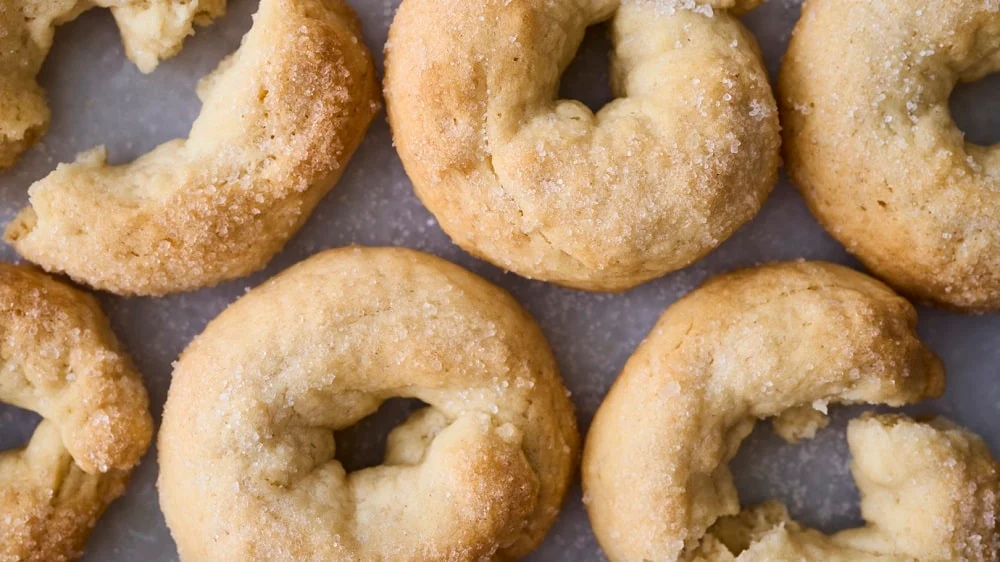
The original recipe for Ciambelline al Vino has remained untouched over time, staying true to its basic principles. No yeast. No butter. No shortcuts. Flour, sugar, extra virgin olive oil, and wine. That’s it—a stripped-back combination that resists trends and modern tweaks, keeping that authentic taste evoking its peasant roots.
The dough is worked by hand, without rushing. You shape the classic ring, dip it in sugar, and pop it in the oven. The oven needs to dry them out, not puff them up. When they come out, they should be golden, dry, and firm. If they turn out soft or crumbly, something has gone wrong. The Roman version is exactly this: just dry enough, meant to accompany rather than melt away, ideal for a moment of pause after a hearty meal.
Red or white wine: the character changes
In tradition, there isn’t just one version. Ciambelline made with red wine have a bolder, more rustic flavour, often tied to more robust local wines. Those made with white wine are more delicate and slightly more fragrant, widely found in the Castelli Romani.
There is no right or wrong choice. It depends on what was in the house, what wine was made that year, and how the person standing at the table liked to cook. This is another reason why Ciambelline al Vino are so strongly linked to memory: every family remembers “their” version, with personal touches that make each sweet unique and unrepeatable.
Ciambelline al Vino at Pistamentuccia
Here, we make our Roman Ciambelline al Vino with red wine, steering clear of forced reinterpretations or unnecessary ingredients. The original recipe stays exactly the same, with just the addition of a little freshly grated lime zest and a touch of aniseed in the dough. This brings a refreshing, citrusy aroma that balances the Roman rustic feel with a bright, unexpected note—something that is never missing at Pistamentuccia.
They arrive at the end of the meal, when you have already eaten well and don’t fancy a heavy, complicated dessert. You pick them up, break them, and maybe dunk them in your wine. There is no need to explain anything else. Rome works like this: few words, clear gestures. E mo’ magna, che ste ciambelle so’ bbòne come quelle de nonna!—Now eat up, because these ciambelle are as good as your nan’s!
If you want to taste properly made Ciambelline al Vino, we are waiting for you at Pistamentuccia, in the centre of Bologna. Here, tradition is neither watered down nor sweetened. It is served with that touch of authenticity that turns a simple biscuit into a piece of family history. Click here and book your table now.